Reading: Shinrin-Yoku (Forest Bathing) and Nature Therapy: A State-of-the-Art Review

This paper Shinrin-Yoku (Forest Bathing) and Nature Therapy: A State-of-the-Art Review from the International Journal of Environmental Research and Public Health, 28th July, 2017 highlights the health benefits of nature. Shinrin-Yoku (also known as Forest Bathing) originates from Japan in the 1980’s when it was realized the health benefits of surrounding yourself and being immersed in nature.

In the paper it is mentioned that Shinrin-Yoku has been known to help prevent a series of physiological and psychological health issues including stress and mood disorders (anxiety and depression), the increase in natural killer/cancer cells (immune system function), ADHD (mental relaxation), hypertension and coronary atery disease (cardiovascular system), respiratory disease and allergies (respiratory system), and it also increases the sense of selflessness and gratitude.

Something I found interesting fro this reading was that although Shinrin-Yoku is only around 35 years old, the practice and knowledge around the health benefits of being immersed within nature goes back thousands of years. The paper mentioned how 2500 years ago, Persian King Cyrus the Great built a lush garden in Persia’s capital city to improve the health of people within the busy city and to create a calming sense. Often it is the old remedies that best heal us and I believe this to be very true in the sense of mental health. We still don’t have a proper grasp on how to deal with mental health and I think that looking back on traditional remedies can often give us a stepping stone towards the answer. We focus too much on moving away from natural remedies we forget to try and understand, improve and use them to our benefit.

This reading has opened my eyes further to the benefits of nature and specifically forest bathing. In my bathhouse design, I want to focus on integrating the calming and peaceful affect into the interior. I also want to focus on making my bathhouse a physically and mentally healing space by using my knowledge from this paper and integrating the forest into the space.

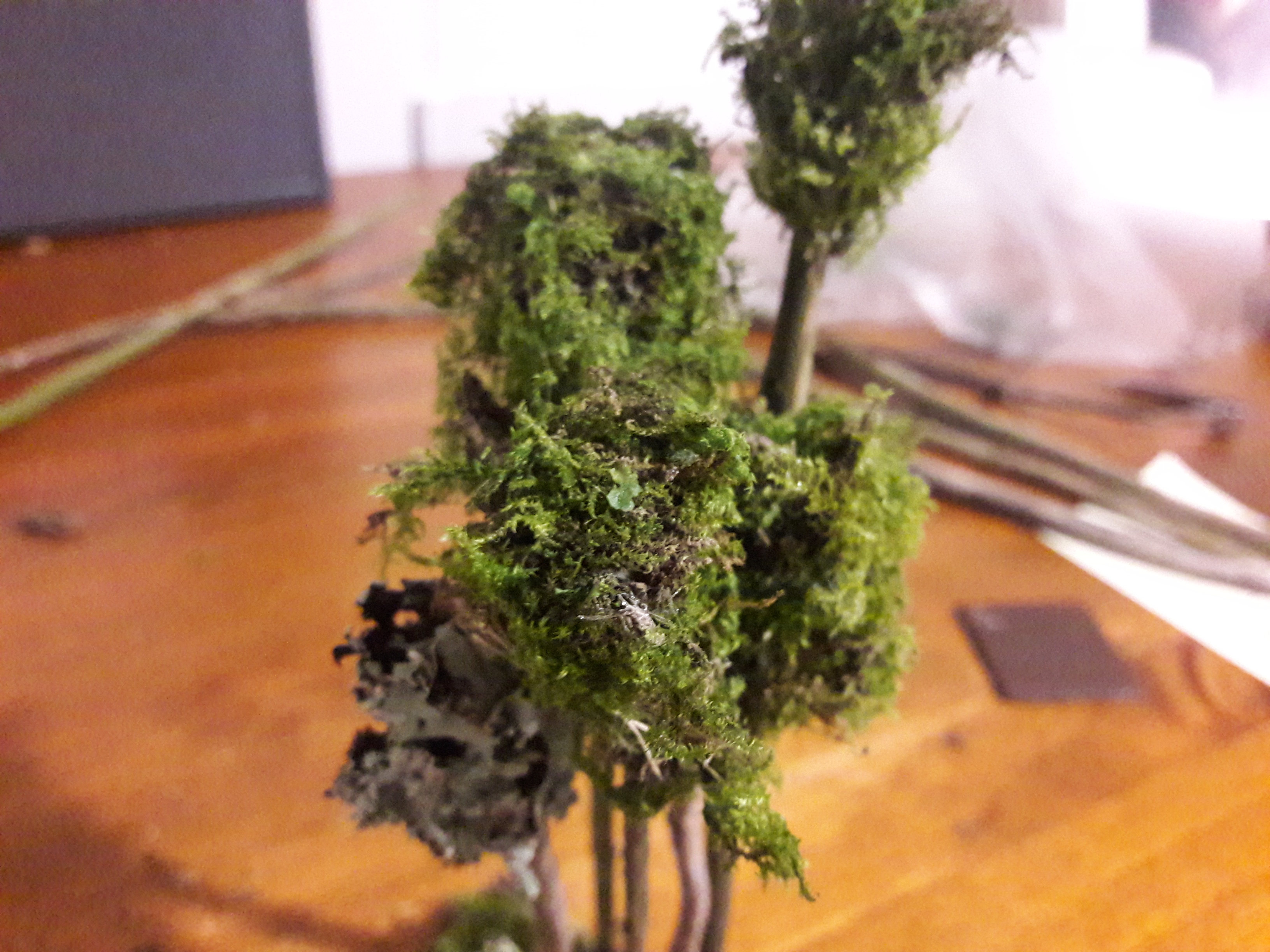
Week 1: Pocket Forest

This week I tried creating my own small pocket forest. I wanted to experiment on the best way to attach the trees to the card and the moss to the branches and also what moss, lichen, and branches worked best in creating the effect of a New Zealand native forest.

I found that, although handy, the lichen I collected didn’t give a realistic look to the trees but was better used for shrubs and plant growth on the forest floor. I liked how the moss I used was such a vibrant green but I am not sure how long it will hold its colour.

After looking at other peoples mini pocket forests I was able to learn ways and techniques of making it look more realistic and natural.

Week 1: Site Visit

This week we were introduced to the project and the site in which we will be designing. The Dadley Building, located on Mount Street, was originally built for the Crippled Children’s Society in the 1960’s. The building was used as a health centre in which activities and facilities with health benefits were supplied to challenged children. These facilities included a bathing area in the basement and a sunbathing area on the top floor. When purchased by AUT, the building housed the students and staff of Spatial Design and Textile Design up until 2018 when it was decommissioned for earthquake proofing.

When observing the building, I noticed the constant shift and changing of materials and their wear throughout the space. The contrast, layering and imperfections in the flooring and ground in the courtyard and the ceiling and walls in the basement articulate the history of the space and its development and altercation over time. They are the visual representation and imprint of time on the building.

Semester 2, 2019

This semester we are designing a bath house in the basement and courtyard of the Dadley Building on AUT City campus. When designing this space, we have to consider the importance of New Zealand’s natural forest flora and fauna and how this can be integrated into our designs. I’m excited for this project because it is something different but I am still able to build on knowledge and ideas from last semester as it plays with the idea of the combination of public and intimate moments. I think this project will definitely have its difficulties especially with the space we’re working with but I also think that it gives so many new opportunities to explore as a designer.

Week 14: Presentation

Project 3 Presentation
TOP: Plan
BOTTOM: Section AA
TOP: Section BB
BOTTOM: Elevation
Atmospheric Interior Photo and Drawing 1
Atmospheric Interior Photo and Drawing 2
Site Map
Site Map Information
Models
1:20 Sleeping Hammock Model
1:50 Gallery Model

From my presentation, I was able to identify what needed to be improved and worked on in my design. One point highlighted was that I could use the space in the front of the gallery more effectively by designing more into this space. Another point was that the back of the gallery and the entrance were very separate spaces. I think this is due to me designing Project 2 and Project 3 so separately. I believe that to there is always ways to improve and develop ideas and if I were to do so with this design I would create more flow between the back and the front of the gallery and therefore utilise the space better.

I am proud of my final design and how far I have come in the past 3-4 months. I think I have improved immensely on my model making, drawings, design process and ways of thinking in a design context.

Week 12: Site Map

This week I worked on my site map. I wanted my site map to be more formal and explanative of how the site influences my design and what I am focusing on and taking from it. In my site map I investigated the use of the building in which the St Paul St Gallery 3 is located. The Te Ara Poutama building located on Wellesley St is part of the AUT City Campus. it is used by hundreds of students and staff every day. In my site map I wanted to explore how the students and their movement influences and defines the site as well as how the site influences and defines them as it is one of AUT’s oldest buildings.

Week 11: Interior Views

After I finished modelling the 1:50 model of the whole gallery space, I took some interior atmospheric photos. It was here that I was able to capture the experience of the occupants.

From here, I worked on some interior perspective drawings. I really enjoyed drawing from my images and how similar yet different the drawings were. From these I was able to explore the light, transparency and movement captured in the space.

The reason I chose tulle as my material and the reason I made it to drape over the floor was because it was able to flow and be manipulated but it was also stiff enough to hold its form. This drawing allowed me to capture and record the movement within the space visually.

Week 10: Bathroom/Dining Areas

In my previous post, I talked about having my sleeping hammock encroach on the dining and bathroom space although I don’t want the bathroom and kitchen override and take focal point of the space. I decided that having them in hidden away cupboards allowed me to ensure that the space, sleeping hammock and entrance design weren’t compromised. This idea also allowed me to change the space was used. the cupboards are opened and entered through doors which become difficult to open when someone is sleeping.

In the dining cupboard there is a fridge and a table and stools which can be moved into the space. I decided to open the cupboard with one large door because having two would mean that when they are open, the left-hand door would divide the gallery into two spaces. This didn’t work because I wanted to enhance the vulnerability felt by the students as the space is very exposed to the public. There is only a thin, sheer curtain between where the students sleep and the outside world and this almost makes them dependent on the other to feel safe. Dividing these two would take away from this effect.

Dining Area

The bathroom cupboard is more exposed. I wanted to play on the idea that the bathroom is one of the most intimate and personal spaces in our everyday lives. I enhanced this vulnerability by having two outward opening doors that are one meter lower than the ceiling. This means that the sound from the bathroom travels throughout the space. I also enhanced the vulnerability factor by making half of the door a frosted glass. This means that the stranger can see the distorted shape of the other while they are in the bathroom. I made the glass at shoulder height allowing some privacy amongst the vulnerability.

Bathroom Area

Week 10: Stranger Context

I have decided to design for two strange AUT students studying different degrees who live at home. The reason I made this decision was based off my own university experience. Living in East Auckland means that I must travel a long distance into uni and therefore I spend majority of my time in uni in class or working on assessments. I have found it hard to meet new people that are not in my classes. My design is a means of creating relationships with people you would not necessarily meet.

Communication is key in building relationships. The new generation is becoming noticeably lacking in face-to-face communication. This is why I designed my space to force the students to communicate and interact. The textile used in the entrance and sleeping hammock provokes movement, influencing and manipulating the space and the students. This allows the students to communicate through movement. I also plan on designing the hammock in the gallery space where it encroaches on the dining and bathroom space, forcing the students to talk to each other in order to move around and use the space. It will make them dependent on each other. By putting this pressure and uncomfortableness on the students, a relationship can be formed based on the true people they are and their traits, not just the facade we sometimes show.