Using the translucent material used in the entrance creates a flowing affect in the space and also amplifies the vulnerable atmosphere. As movement is a large factor in my design, I am making the sleeping hammock available to move along a track at the back of the gallery space.
Author: ciaraannmaher


Week 9: Entrance Development
One point I took from the last part of the project was to explore the material and textile of the entrance and exit. In order to continue the flowing and light yet vulnerable atmosphere, I decided to use a translucent fabric that falls elegantly. The fabric is very responsive to movement which helps in demonstrating the important feature of movement in my design.


After deciding that the space needed a bit of colour, I pushed my design even further. On a second track, I created a curtain of red tulle. The tulle represents the uncomfortableness experienced by the strangers as it is rough and not as flowing as the white transluvent fabric. I chose red because it is a colour associated with ergency and gets the heart reacing. This is a contrast to the soft, flowing white and neutral colours of the rest of the space.


In my redesign of the entrsnce, the white curtain sits perfectly on the floor, creating a sense of serenity and protection whereas the red tulle is longer drooping on the floor. This forces the occupants to move around it.

The tulle also vocalizes movement as it creates defined visible folds. I want the design to not only infuence the occupants but also llow the occupants to influence it and therefore influence eachother.
Week 9: Further Platform Development
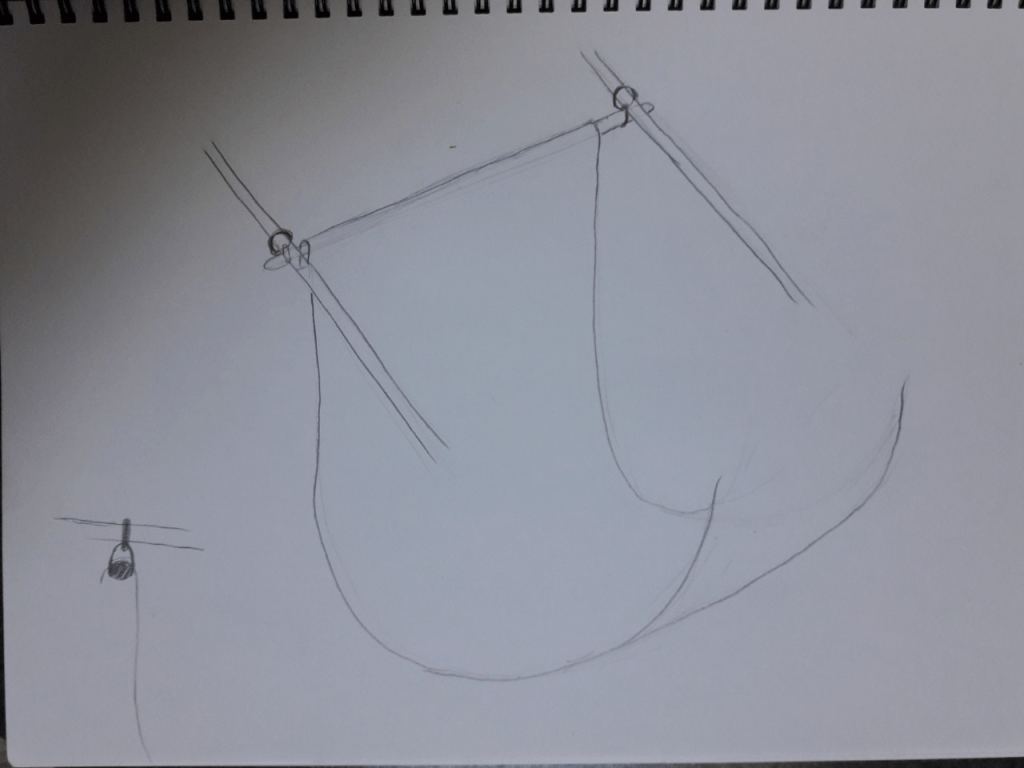
After deciding on my sleeping platform design, I explored different ways I could explore joins and attachments.


I decided on using a simple hoop connecting the poles to allow a smooth movement.
Week 9: Sleeping Platform Development
After creating my initial designs for the sleeping platform, I developed the ideas that I thought best created the sense of safety and security but also a sense of exposure and vulnerability (below).

I liked how this design gave the occupant a sense of own personal space and enclosure, but this was challenged by the flowing movement and translucent material. By exposing these strangers to one another in an individual and intimate moment challenges my own views and ideas of comfort and peacefulness. I confront the strangers with the interchanging sense of peace and vulnerability.
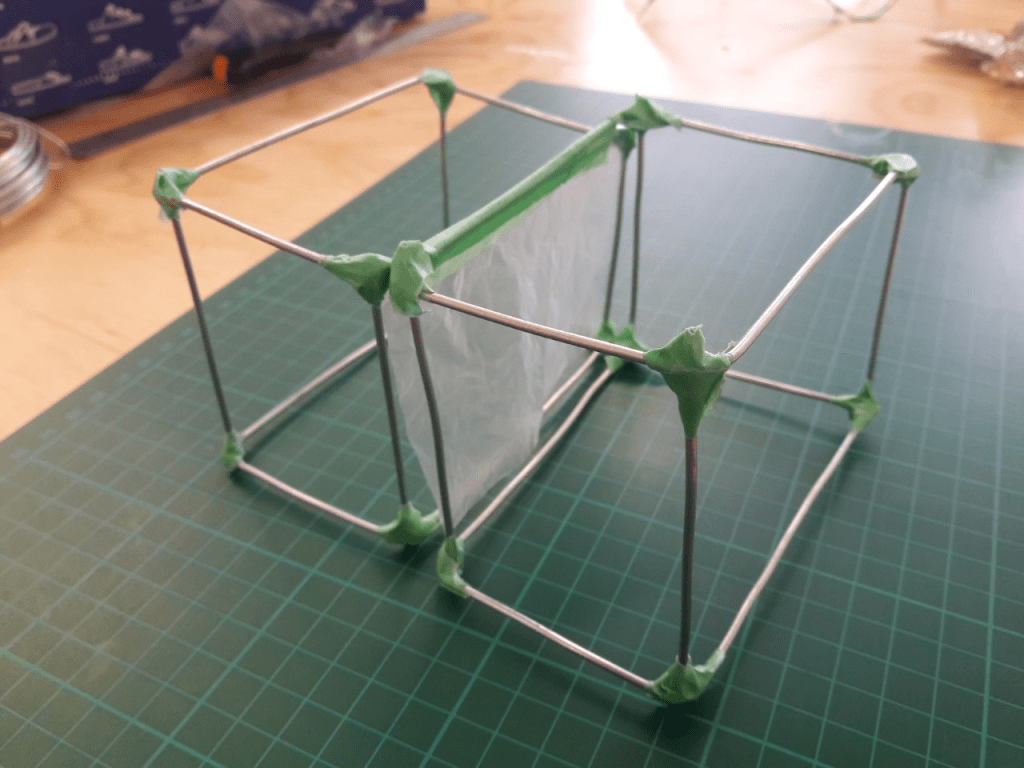
From this design I created a few new iterations (below).
Development 1 
Development 2 
Development 3

Development 4
These designs ultimately led to my chosen design of a double hammock.
Designer Research: Ann Hamilton
Ann Hamilton is an American Visual Artist well known for her large multimedia installations. What I love about her work is how its large scale makes it more elegant. Hamilton also with her installations creates a space and atmosphere with such simple yet effective designs. A prominent feature of her work that really interests me is how her installations are very interactive.

https://www.annhamiltonstudio.com/projects/armory.html
This project “the event of a thread” by Hamilton really highlights and emphasises interacting with the piece. What I love about this design is how the textile is altered and manipulated by those who encounter it. Large swings used by the occupants cause the large design to influence and move which changes the experience of those lying beneath it.

https://www.annhamiltonstudio.com/projects/habitus.html
This project “habitus” by Hamilton emphasise form and movement and how these influence each other. This design is a series of circular curtains that rotate when initiated by the pulling of the long ropes hanging from the ceiling. What I love about this project is how the form is manipulated by the movement which is a result of the human interaction with the space. This piece really interests me in the idea of occupants being able to influence a space to their liking, giving that freedom.

https://www.annhamiltonstudio.com/projects/air_for_everyone.html
This project “air for everyone” also investigates the manipulation of form through movement as a result of an uncontrollable factor, nature. What I find interesting about this design is how the sheer, delicate and elegant textile directly contrasts the old, hard, weathered building. Again, I love the manipulation of form through movement and also how this allows a visual representation of movement and air flow.
When further developing my own design I want to consider more how the occupants of my space can influence and interact with the space and design. I also want to look more into how I can design a space that takes a visual record of movement and uses this to manipulate the experience and atmosphere.
Week 8: Initial Sleeping Platform Prototypes
This week we began part three of this sleep/wake design project. We began with quick, rough prototypes of possible sleeping platforms for our design. I based these initial designs off the materials and concepts I had used in both Project 1 and Project 2 as I was familiar with them and they created the base of the atmosphere I wanted to create. These are my initial designs.


Week 8: Presentation
This week we presented our Project 2 work. It was really good to present because I was able to explain my work and also get some helpful feedback. I liked how the crit session this time was more relaxed so I was able to enjoy both listening to other peoples presentations more and presenting myself.


What I got from the crit were some ideas on how I could develop my design moving towards Project 3. Some of this feedback included looking more into the materiality of my design and maybe developing my own textile. This is a really cool idea but I know it will challenge me as I haven’t done anything like it before but that is how I’m going to learn and broaden my skillset.
Another point raised in during my presentation was that because my design is quite simplistic so every little detail has an affect on the overall end result. I was also suggested to start looking more into light being an aspect in my design.
Overall, I think my presentation went very well and that I now have some pointers snd ideas for moving forward into Project 3.
Week 7/Mid-semester Break: Modeling
Modelling the gallery took time. I have never done any sort of modelling before this year and this was my first time modelling to replicate a space. I id spend a lot of time on it make sure it looked perfect but I am happy with the way that it turned out. I feel that over time my modelling skills will improve and I will become faster at modelling spaces.
While designing the gallery space I thought a lot about the design I was going to put into the space. I originally thought that the whole gallery and Wellesley St entrance was my threshold moment but I struggled with creating a design that could be created in that whole space, that linked to my Project 1 by creating a sense of distortion and uncertainty and one that wouldn’t interrupt the use of the lobby as it is used by hundreds of AUT students a day. This is when I decided that in order to create an effective design that physically represented the threshold between moving from an awake, reality state into a sleeping and dreaming state and vice versa, I would position my threshold design between the lobby and the gallery space.
After some research into her work, I really drew inspiration from Petra Blaisse. Like in my Project 1, I used a thin frosted transparent film and this created the distortion and uncertainty we experience in the threshold between dreaming and being in reality. Her work inspired me to create a design that not only guided movement around a space but also evokes it through the people who move among it.
The film I decided to use created the effect I wanted. I like it how you can’t quite see through it but blurry shapes can made out. Also, the level of distortion of an object depends on its proximity to the sheet. This creates a visual representation of what it is like for me when I’m in between sleeping and awake and my dream morphs into the reality around me.
When deciding the path that these suspended sheets would follow, I really considered the flow of movement in the lobby and gallery space. I wantd to guide people through the front of the gallery, past the windows and then move them deeper into the space as the lighting becomes less prominent. The flowing film allowed me to guide movement within the space and helps to avoid the rigidness that may restrict visitors. This design is heavily based on movement.
I wanted the design to create an experience before even entering the gallery. For my entrance, I removed three sections of the wall between the lobby and the gallery. In order to create some kind of barrier between the awake stage (lobby) and the sleeping stage (gallery), I created a curtain that covered two of the openings and moved away to allow an entrance in the opening closest to Wellesley St. This created the uncertain, flowing and forever changing barrier and threshold between sleeping and awake. It also allows the movement of the lobby to influence the gallery space. There is no defining line between sleep and awake.
To create more flow and freedom in the space, I made the decision to have a break in the curtain. This opened the gallery up more and helped in not creating confined, awkward spaces. I had originally planned to have two separate tracks for the two separate curtains (first track seen below) but decided that it would be more effective o have them on the one track. By having them on the same track, the curtains could be moved around the space creating different configuration, an example of how the threshold between dreaming and reality is never the same and always ever changing. Having the one track also replicated the consistent flow of movement through and into the space.

I also had to decide on a way to suspend the curtain from the track in a way that it allowed it to move freely. After a few different ideas, I decided on my last design (right) because it was the most tidy and elegant, fitting with the ambiance I have been trying to convey. (Left: First attempt, Center: Second attempt, Right: Final design)


Something I found difficult about modelling was the modelling of my threshold design. One of the points that made it difficult was that it was small and fiddly. Another point was that my design is supposed to be suspended from the ceiling but I wanted to be able to view it from above as the shape of the track is so important to my design. Having to suspend my design without a ceiling was difficult but I am really happy with the end result.


After finalizing my design and modelling it, I found it a lot easier to draw it in my plan and section. For my final document, I needed to change my section as the view into the lobby didn’t express my design the best way possible. On my final I drew my section looking into the gallery space from the East facing wall which described my design a lot more effectively.
For my threshold interpretation of the space I focused mainly on movement and a little bit of light as this was a defining aspect in my design.

Designer Research: Petra Blaisse
Petra Blaisse is a Dutch designer well known for her architectural textile designs. Blaisse often creates large scale curtain like structures with an emphasis on the textile design and effect. I really like how she uses a range of materials to create so many different outcomes and how simple but effectively beautiful the designs are. What amazes me is that eventhough they are so enormous in size, they still have a elegant way about them.


Blaisse, P. (2008-2011). Chazen Museum of Art, Wisconsin. Madison, Wisconsin, USA
https://www.insideoutside.nl/Chazen-Museum-of-Art-Wisconsin

https://www.insideoutside.nl/Maison-a-Bordeaux
Looking at my own design project, I think that Blaisse’s work would be a helpful inspiration. I have already been brainstorming some ideas on my threshold design for the St Paul St Gallery Space 3 and I know that I would like to use some of the affects I created in my Project 1 such as the distortion and uncertainty created by the frosted, transparent film I used in my model. I think that if I adapted Blaisse’s concept of having a moving and flowing textile within the space, I could achieve a design that would evolve from aspects of my Project 1, include my research and analysis so far from this project and it would also have the elegance and beauty portrayed in Blaisse’s work that I very much admire.
Week 6: Site Section
After exploring the hresholds in the gallery space in my 1:50 plan, I needed to create a threshold design for entering and exit the space. At the beginning of this design process, I considered my threshold to be moving from Wellsley St, up the front entrance of the Te Ara Poutama builing into the lobby, and then into and through the gallery space. Before designing my threshold, I drew my section as to what would best show what I would design so I created a section of the building through the lobby looking at the gallery.

After drawing the section, I explored the threshold points in the lobby and outside underneath the portico on Wellesley St.

I found designing my threshold moment for entering and exiting the gallery space quite difficult. I had a few ideas I explored in sketch but I struggled to visualize these ideas. I became stuck and I couldn’t proceed in my design through sketch. This is when I decided to model the gallery space to a 1:50 scale and explore ideas so I could visualize and see it.


Left: A frosted glass box inserted in the wall between the gallery and lobby. This would be a creative entrance and it would also distort what was on the opposite side of the wall. It also wouldn’t impose on the lobby space.
Center: A split curtain on track suspended from the ceiling. This would be a good idea for an installation within the space but not really sure how it could work as an entrance/exit into/out of the gallery.
Right: A series of transparent film suspended from the ceiling layered throughout the gallery with laser cut designs. This would create the unclarity an distortion I want but much like the center design, it would act more as an installation rather than an entrance/exit.
 Spatial Design by Ciara