Week 2: Intuitive Map

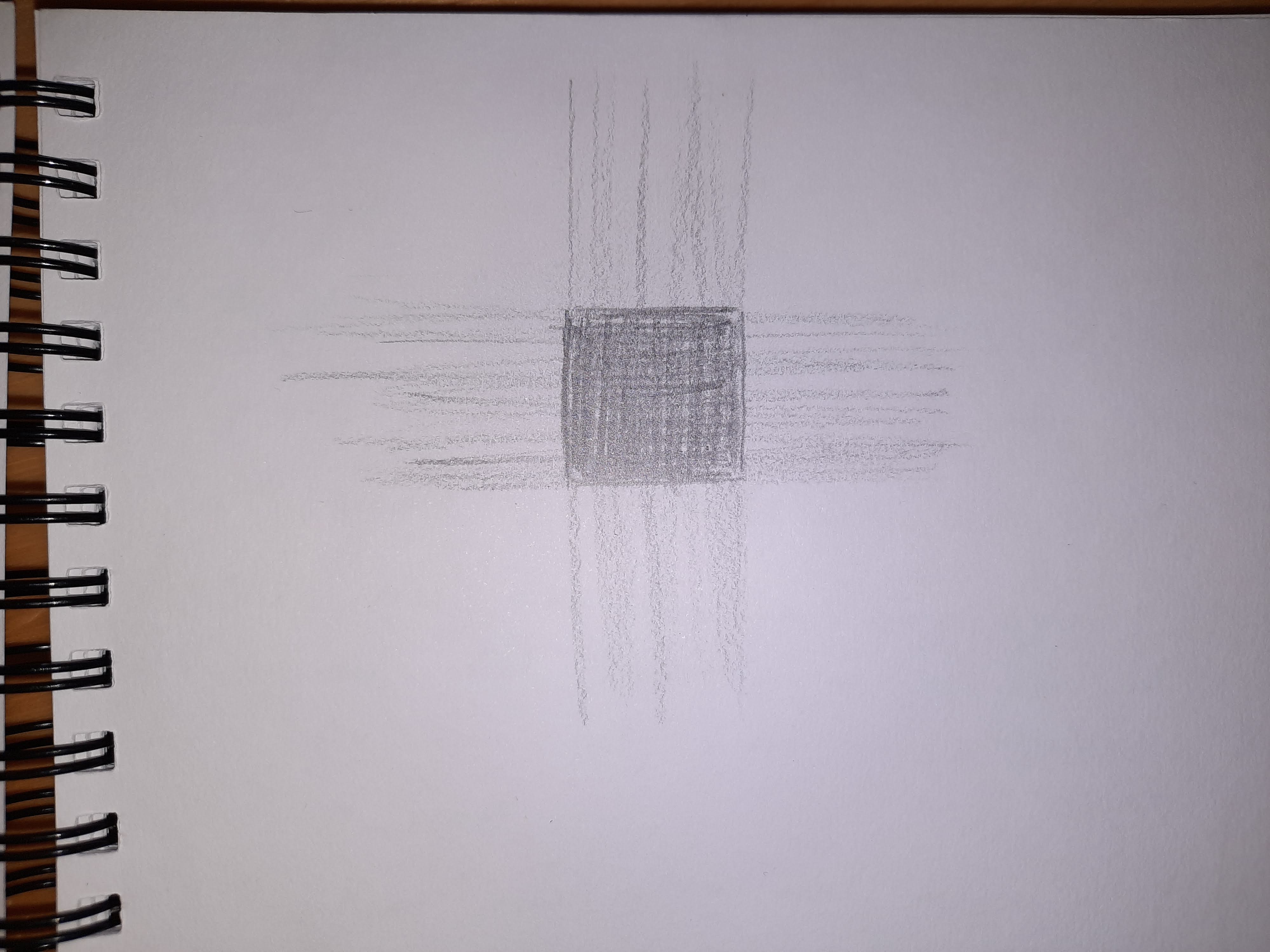
This week we made intuitive maps to help us analyse, organise and interpret our ideas we are exploring about the space. I really struggled with how I was going to interpret my ideas through an intuitive map, but after a lot of thought, I figured out how I would display it. I started with writing out my key ideas and then positioning them in relation to each other depending on how they sit in my mind.

Rom here I was able to figure out how I wanted to display my ideas. I decided to do a vine wrapping round a structure to demonstarte the important ideas of structure and conformity. The stem demonstrated my main/priority idea, and the remaining ideas bled out from that from most to least important and relevant. Below is my intuitive map and my 150 words to explain the site.

150 WORD STATEMENT:
My intuitive map describes the structure and movement of the Mayoral Drive crossing outside AUT WG Building. 
The criss-cross wooden structure is a symbol of the intersection and structure of the crossing and explains the subconscious conformity that exists within the space. 
The creeping vines communicate the conscious organic movement in the space that rejects structure and signals. 
They also explain the organization of my ideas and thoughts about the space and their importance and relevancy. 
The main vine on the right of the page symbolizes my main idea in which all other ideas branch off. 
The closer to the stem, the more relevant and prominent the idea is in my thought process. 
The creeping vines indicate the relationships and connections that ideas have to others. 

Week 1: Social Space Decision

On Thursdays class we brought all of our A5’s together to do an exercise with the selected list of words. Through this and the discussion, I started to look at the spaces we had chosen in more abstract ways instead of literal terms.

I have decided to choose the traffic crossing on Mayoral Drive outside WG building as my site because I wanted to pick a space that is given meaning and context and is created by the people that occupy and interact with the space. I like how the space is not solely defined by physical constructs, but is also largely dependent on movement, interaction and people.

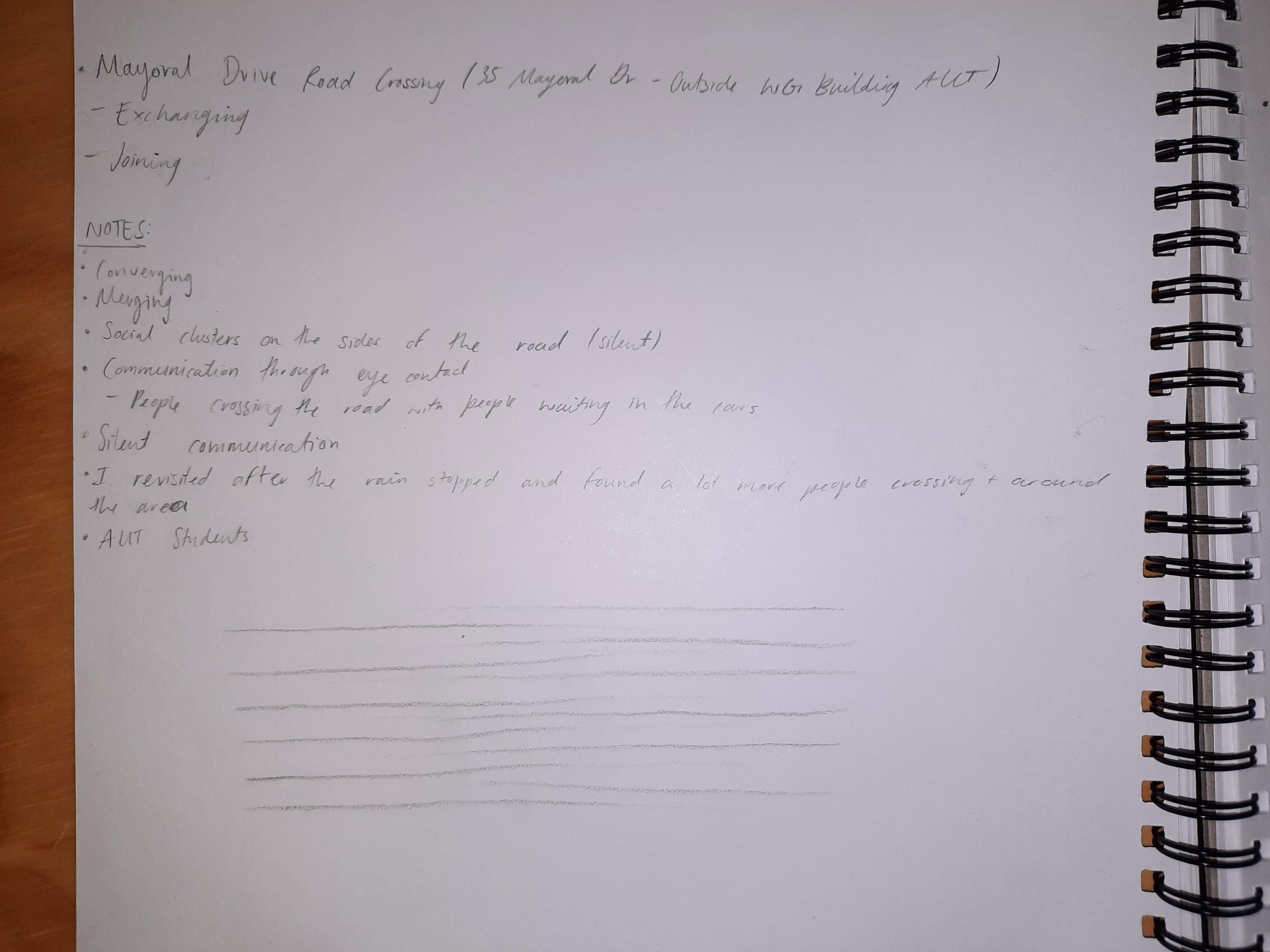
The two words I chose that associate with the space are EXCHANGING and JOINING. I also chose a series of words to help us to start thinking about the space that I found really correlated with the crossing.
SPEEDS
REACTIONS
NEGOTIATIONS
OVERHEARD CONVERSATIONS
EXCHANGES
ROUTES
UNSPOKEN
RULES
EYE CONTACT

I read Species of Spaces by Georges Perec before I went to observe at the site. I found it helpful as an instigator to observation. His work gave me ideas on what to look out for and notice.

I then spent over an hour sitting at my site, observing, and taking notes. I thought I would get bored and sick of siting there but to my surprise, this was not the case. Once I allowed myself to stop, sit down, remove dissociated thoughts, and observe, I noticed that my surroundings were so rich with information that ideas and observations flowed consistently out of me and onto the page. The whole time I sat there, I was taking notes; just as I wrote one observation or idea down, another popped into my head. Below are the notes I took over the hour.

The reason why I decided to take notes in a chronological order in bullet-points was because I wanted to document the breadth ad depth of the site in the context of time. The crossing and its surroundings are constantly changing due to their temporality. documenting like this highlights the importance of time and how dependent the analysis of the site is on it.

Gravitational Pull (100 words):
What originally drew me to the site was the way it acted as a social space but wasn’t confined by the traditional constructs of walls, floor and a ceiling. I have an interest in the way people interact in public with each other and space and the role that unspoken social expectations and rules have on the way a space is interpreted and portrayed. Traffic light crossings are a place where people from all walks of life, with different stories and destinations meet, wait and move together. The crossing is an easily accessible site that allows me to sit and observe in comfort, allowing me to investigate and explore my interest in the role of societal and social expectations, and psychology in space.

Week 1: Social Space Exploration

This week we discussed the brief and what is meant by ‘social space’ and ‘commons’. We were given the task to choose three social spaces, assign 2-3 words from the list given to us to each space depending on how they related, visit the space and observe through note and image taking, and arrange, organise and design my images and notes onto A5 pages.

Below are some images of notes I took in class about social spaces and commons.

The three spaces I chose included the traffic crossing on Mayoral Drive outside the AUT WG Building, Level 1 of WG AUT Building, and Albert Park. Below are some of the notes and images I took of the spaces.

From these, I created an A5 page for each one depicting my observations of the spaces.

Semester 2, 2020

I am really looking forward to this semester. It is so good to be back on campus and be able to work in studio with my peers again. I definitely am able to appreciate having a space to work and being surrounded by my friends and peers. As far as I can tell so far, I like the brief. I like the slightly different approach to studio and like the concept of ‘Social Space’. Last semester I really found a passion and interest in human actions, thoughts and psychology in space and this brief allows me to explore this further.